
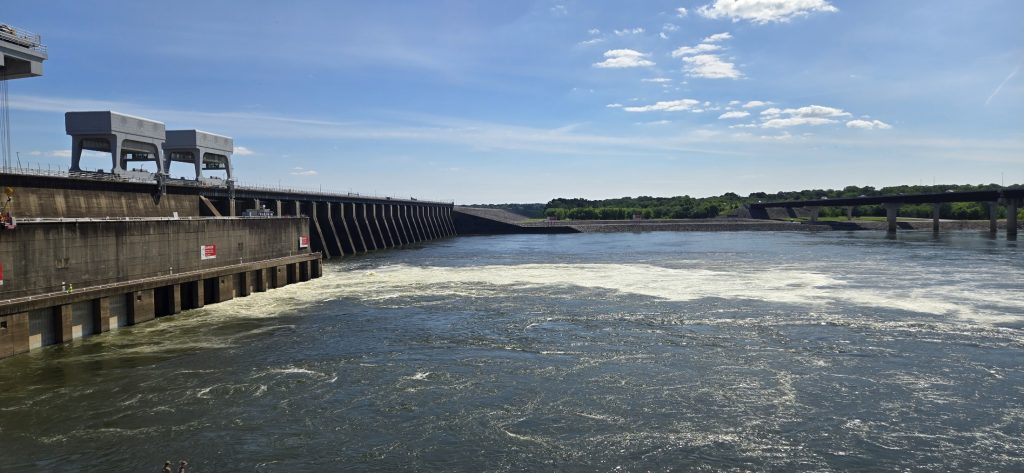
We get a lot of questions about water depth from buyers shopping for lake properties. Our lakes are gigantic with depths at the main channel reaching 70-75 feet. Kentucky Lake is 2 miles wide in some places and 184 miles long. However, water depth on the shorelines vary quite a bit depending on the location of the property and the season.
If you are shopping for waterfront property around Kentucky Lake or Lake Barkley, understanding water depth is extremely important.
Main Lake vs. Bays
In general, water along the main lake channel is much deeper than water inside protected bays and coves. However, there is a tradeoff that some buyers do not realize right away.
There are areas along the main channel where TVA (Tennessee Valley Authority) or the Army Corps of Engineers do not allow private docks because of heavy boat traffic and navigation concerns. So, while the water may be deep, the property may not qualify for a dock permit. These properties are marked as “not open to moorage” in the MLS.
On the other hand, just because a property is located in a bay does not mean the water is shallow. Some bays around Kentucky Lake and Lake Barkley stay surprisingly deep year-round, while others become very shallow during winter pool.
Generally speaking:
- The closer a property is to the main channel opening, the deeper the water tends to be
- The farther back into the bay you go, the more shallow it becomes
- Some bays naturally hold deeper water than others
One thing we often suggest to buyers is pulling up the property on satellite view in Google Maps to see where it sits within the bay or cove.
Water Levels Change with the Seasons
Both Kentucky Lake and Lake Barkley are regulated lakes, with water levels managed by TVA and the Army Corps of Engineers. The lake levels are lowered in the winter to reach 354’ from December 1st to March 31st. The summer pool water level is at 359’ May 1st through July 4th.
In many shallow bays, it is not unusual during winter pool to see docks sitting on muddy ground or barely floating in a couple of feet of water. For many owners, that is not a big concern because they store their boats during the off season and do not plan to use their docks from December to March.
How Do You Know How Deep the Water Is?
The best way to truly know the water depth at a property is to visit in person and physically check it. Let’s go out to a property together and take a look at the area around the dock. In the winter, you can often see the summer pool water line along the shore. This can help you visualize how the water level will change.
If you visit during summer pool, it is important to remember that winter water levels are typically about five feet lower. A dock that looks perfect in July may have much shallower water in January.
If you cannot visit in person right away, satellite imagery can still be very helpful. On Google Maps, darker water usually indicates deeper areas, while lighter colored water often shows where the lake bottom becomes more shallow. This is especially noticeable on winter satellite photos.
While it is not a perfect measurement, it can give buyers a surprisingly good idea of the depth around a dock or shoreline.
Talk to a Local Realtor
Water depth is one of those things that can be hard to fully understand from listing photos alone. As local agents, we are familiar with many of the lake neighborhoods and can often help buyers identify areas that tend to offer deeper water access.
We understand that many of the people who visit our site are planning for a future move and do not intend to purchase property right away. We encourage future clients to reach out to us with any questions they might have about the lakes regardless of their intent to purchase or timeline.
Deep Water Usually Comes at a Premium
One thing buyers quickly discover is that properties with year-round deep water and private dock opportunities are usually in high demand.
If deep water access is important to you, it is important to be prepared for those properties to come at a premium compared to shallower waterfront lots.
That said, the right property depends entirely on how you plan to enjoy the lake. Some buyers are perfectly happy with seasonal water, while others plan to access their boats even in the winter months.

Pingback: Dock Dredging on Kentucky Lake and Lake Barkley: Your Questions Answered - Kentucky Lake Real Estate